

Understand Your Electric Bill
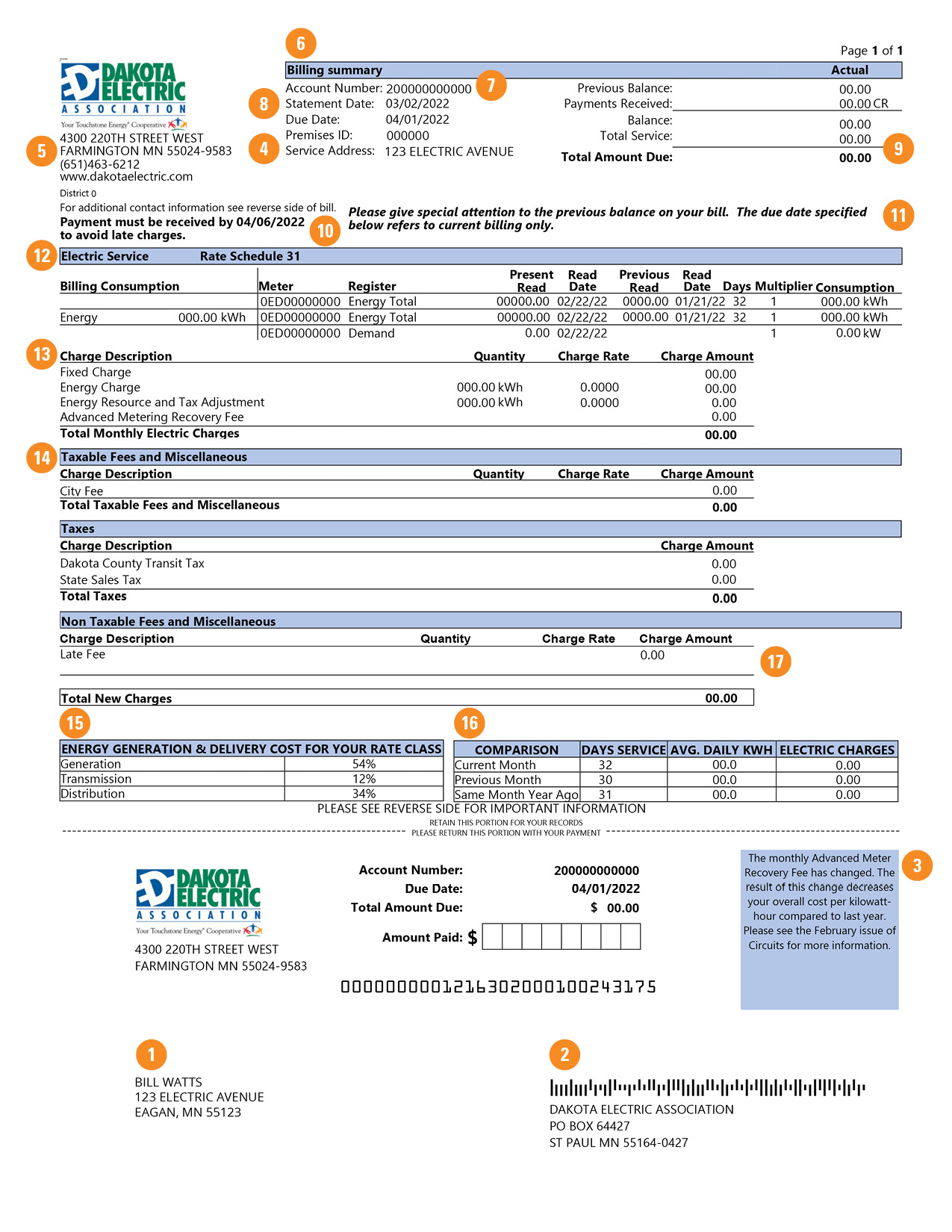
11. Change information message area
• If you participate in electronic funds transfer and have automatic withdrawals from your checking or savings account, the message will state the date the balance will be withdrawn from your account.
• You may also see a message that you do not participate in electronic funds transfer, but you have a balance from a previous bill.
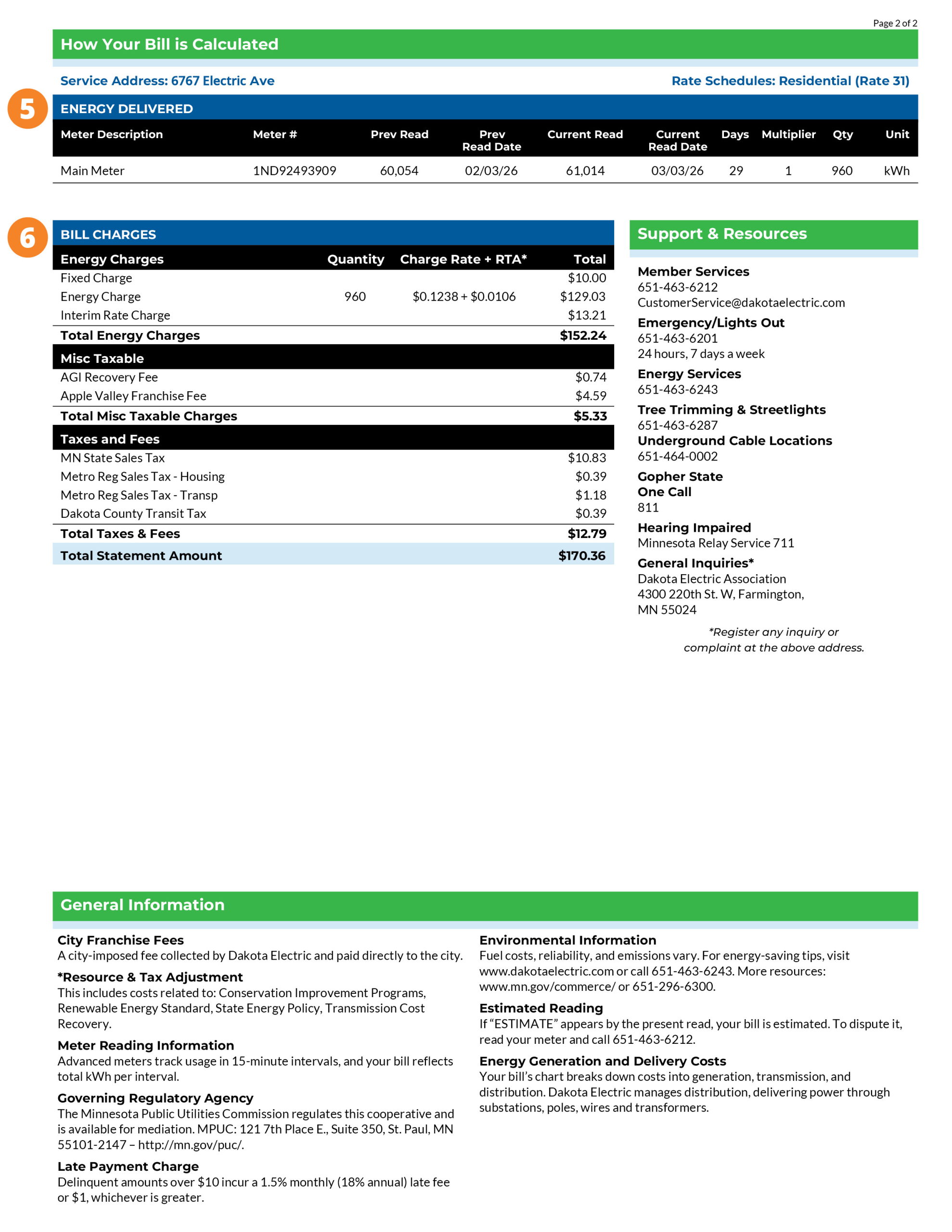
12. Electric service
• Has information about your meter.
• Includes meter serial number, present meter reading, previous meter reading and whether the reading was a regular reading by a meter reader or an estimated reading.
• Metering equipment for the account determines the multiplier number.
• Usage period shows the meter reading dates and the number of days in the billing cycle.
• Rate schedule listed, below the meter number, is used to calculate your bill.
• The electricity you use is measured and billed in kilowatt-hours (kWh).
13. Charges
• Fixed charge – The fixed charge is for expenses incurred regardless of how much electricity you use, such as monthly costs for metering and billing.
• Energy charge – The energy charge is for generating electricity and delivering it to your home. The total amount of energy (kWh) you use is multiplied by the charge for each kWh. The charge for each kWh varies by account and can be found in the residential rate schedule.
• Resource and Tax Adjustment – Dakota Electric uses the Resource and Tax Adjustment to adjust electricity prices according to changes in wholesale power, property and real estate tax that occurred since we last set our energy rate. Learn more about the Resource and Tax Adjustment
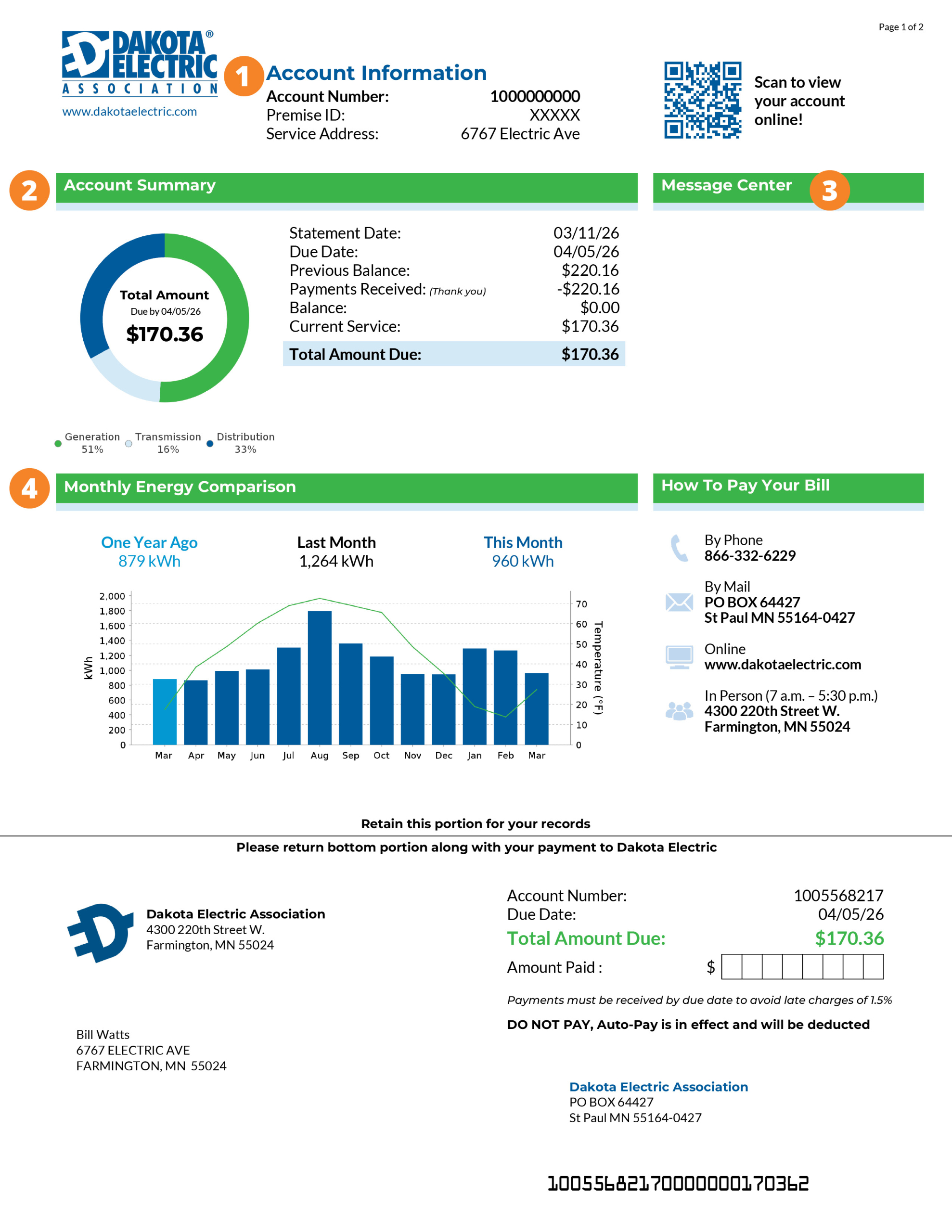
1. Mailing address
• The name and address of the individual(s) or business responsible for the account.
• The mailing address may be different than the actual service address.
2. Payment address
• This address is for payments only.
• All other correspondences should be sent to Dakota Electric’s headquarters office at 4300 220th St. W., Farmington, MN 55024
3. Message box
• Contains money saving ideas, event dates and other important information for members.
4. Service address
• The address of the location with electric service being billed on this bill.
• May be different than the mailing address.
5. Member service information
• Information about when and how to contact our members services department.
6. Billing summary
• Lists the amount of your previous bill, payments applied to your account since your last statement, late charges, account adjustments and loan payment amounts.
7. Account number
• A unique numeric member account identifier.
• When you contact us, please provide us with this account number for the fastest service.
8. Statement date
• The date your bill is prepared.
9. Total amount due
• The amount you must pay by the due date to avoid late charges.
10. Payment must be received by to avoid late charges
• The date Dakota Electric must receive payment by to prevent late charges.
• A late payment charge of 1.5 percent on any unpaid balance of more than $10 will be applied to the next month’s bill if payment is not received by the date specified.
• Minimum late charge is $1.
14. Taxes and fees
• Franchise fees – Based on a percentage of the member’s monthly bill, Dakota Electric makes no profit from the collection or payment of these fees. The percentage can vary depending on the city you live in, and the fee is required by our franchise agreement with some cities.
• Dakota County Transit Tax – Dakota Electric collects a transit tax on bills of members from Dakota County. The tax applies to anything subject to general sales tax, and Dakota Electric makes no profit from the collection or payment of the tax.
• Sales tax – State tax rate set forth based on taxes as of January 1, 1991. The amount of any increase in existing or new taxes on the transmission, distribution, or sales of electricity allocable to sales hereunder, excluding real and personal property taxes already recovered through the RTA, shall be added to the above rate as appropriate.
15. Energy generation & delivery cost
This table shows how much of your monthly bill is used for generation, transmission and distribution of your electricity. The chart will vary for different rate classes.
16. Comparison chart
This chart compares your electricity use for the current month, previous month and same month from the previous year.
17. Account message box
These messages refer specifically to your account and may include messages about your budget billing renewal or adjustments to your account.
1. Mailing address
• The name and address of the individual(s) or business responsible for the account.
• The mailing address may be different than the actually service address.
2. Payment address
• This address is for payments only.
• All other correspondences should be sent to Dakota Electric’s headquarters office at 4300 220th St. W., Farmington, MN 55024
3. Message box
• Contains money saving ideas, event dates and other important information for members.
4. Service address
• The address of the location with electric service being billed on this bill.
• May be different than the mailing address.
5. Member service information
• Information about when and how to contact our members services department.
6. Billing summary
• Lists the amount of your previous bill, payments applied to your account since your last statement, late charges, account adjustments and loan payment amounts.
7. Account number
• A unique numeric member account identifier.
• When you contact us, please provide us with this account number for the fastest service.
8. Statement date
• The date your bill is prepared.
9. Total amount due
• The amount you must pay by the due date to avoid late charges.
10. Payment must be received by to avoid late charges
• The date Dakota Electric must receive payment by to prevent late charges.
• A late payment charge of 1.5 percent on any unpaid balance of more than $10 will be applied to the next month’s bill if payment is not received by the date specified.
• Minimum late charge is $1.
11. Change information message area
• If you participate in electronic funds transfer and have automatic withdrawals from your checking or savings account, the message will state the date the balance will be withdrawn from your account.
• You may also see a message that you do not participate in electronic funds transfer, but you have a balance from a previous bill.
12. Electric service
• Has information about your meter.
• Includes meter serial number, present meter reading, previous meter reading and whether the reading was a regular reading by a meter reader or an estimated reading.
• Metering equipment for the account determines the multiplier number.
• Usage period shows the meter reading dates and the number of days in the billing cycle.
• Rate schedule listed, below the meter number, is used to calculate your bill.
• The electricity you use is measured and billed in kilowatt-hours (kWh).
13. Charges
• Fixed charge – The fixed charge is for expenses incurred regardless of how much electricity you use, such as monthly costs for metering and billing.
• Energy charge – The energy charge is for generating electricity and delivering it to your home. The total amount of energy (kWh) you use is multiplied by the charge for each kWh. The charge for each kWh varies by account and can be found in the residential rate schedule.
• Resource and Tax Adjustment – Dakota Electric uses the Resource and Tax Adjustment to adjust electricity prices according to changes in wholesale power, property and real estate tax that occurred since we last set our energy rate. Learn more about the Resource and Tax Adjustment
14. Taxes and fees
• Franchise fees – Based on a percentage of the member’s monthly bill, Dakota Electric makes no profit from the collection or payment of these fees. The percentage can vary depending on the city you live in, and the fee is required by our franchise agreement with some cities.
• Dakota County Transit Tax – Dakota Electric collects a transit tax on bills of members from Dakota County. The tax applies to anything subject to general sales tax, and Dakota Electric makes no profit from the collection or payment of the tax.
• Sales tax – State tax rate set forth based on taxes as of January 1, 1991. The amount of any increase in existing or new taxes on the transmission, distribution, or sales of electricity allocable to sales hereunder, excluding real and personal property taxes already recovered through the RTA, shall be added to the above rate as appropriate.
15. Energy generation & delivery cost
This table shows how much of your monthly bill is used for generation, transmission and distribution of your electricity. The chart will vary for different rate classes.
16. Comparison chart
This chart compares your electricity use for the current month, previous month and same month from the previous year.
17. Account message box
These messages refer specifically to your account and may include messages about your budget billing renewal or adjustments to your account.
Understanding your electric bill is more than just deciphering a set of numbers and charges — it is a key to managing your energy consumption, saving money and promoting a sustainable future. Understanding your electric bill empowers you to take advantage of Dakota Electric’s energy-saving programs and rebates which allow you to optimize your energy usage. For more information on our programs and rebates, visit the programs and rebates page.
(Click image to enlarge)